User manual
ADMETatlas user manual
How to find, read, and reuse the curated peptide ADMET evidence in ADMETatlas — the entry points, record pages, evidence tables, and API, with the interpretation rules that keep each value scientifically faithful.
Start here
New to ADMETatlas? These four moves cover almost everything. Each record page answers a different question; the rest of this manual explains how to read what you find.
Open the right page
Peptide, product, endpoint, and evidence pages each answer a different question.
See the data modelRead in context
Identity, unit, assay context, evidence layer, and provenance only mean something together.
Reading the evidenceReuse responsibly
Pin the release, keep the status and provenance fields, and cite the upstream references.
API accessWhat ADMETatlas is — and isn't
ADMETatlas is an evidence atlas, not a prediction service. Knowing the difference is the key to reading it correctly.
ADMETatlas is
- +A curated atlas of measured and reported peptide ADMET evidence — every value tied to its assay context and a traceable reference.
- +Organized by stable identity (peptide and product) and the five formal ADMET domains plus a physicochemical category used across the site.
- +A reproducibility surface: every record is reachable by a stable ATL ID in the pages and the API.
ADMETatlas is not
- −Not a predictor or calculator — it reports observed evidence and does not estimate values for new sequences.
- −Not a scorecard — it does not assign an overall safety, BBB, or developability verdict to a molecule.
- −Not a pool of interchangeable numbers — values are comparable only within a matching endpoint and assay context.
How the data fits together
Every record is an object with a stable identifier, joined to other objects by explicit relationships. This single picture explains almost every page and query.
The canonical molecular identity a record resolves to.
One resolved form of a backbone (specific sequence/representation).
A marketed or tracked drug, connected to identity only through a reviewed link.
One evidence entry: a value with its unit and inline assay context.
A formal endpoint property, grouped under the five ADMET modules plus a physicochemical category.
Trial, label, safety, or identity context bound to a peptide or product.
The publication, label, registry, or dataset a row traces back to.
Entry pointSearch
Search accepts names, ATL IDs, endpoint terms, and raw peptide sequences, then links to matching records.
What you see
- •Global text search across public peptide, product, endpoint, and measurement records.
- •Entry through stable ATL IDs, generic or product names, endpoint labels, and raw peptide sequences.
- •Result rows that link straight to the peptide, product, endpoint, or evidence page.
How to use it
- 1Use an ATL ID when you already have one, for example ATLPC0009237.
- 2Use a generic or product name when starting from clinical or label context, for example semaglutide.
- 3Use a raw sequence when the molecule is known but the identifier is not.
- 4For an endpoint term such as permeability, continue from Endpoints or Evidence rather than reading search hits as data.
Molecular recordPeptide records
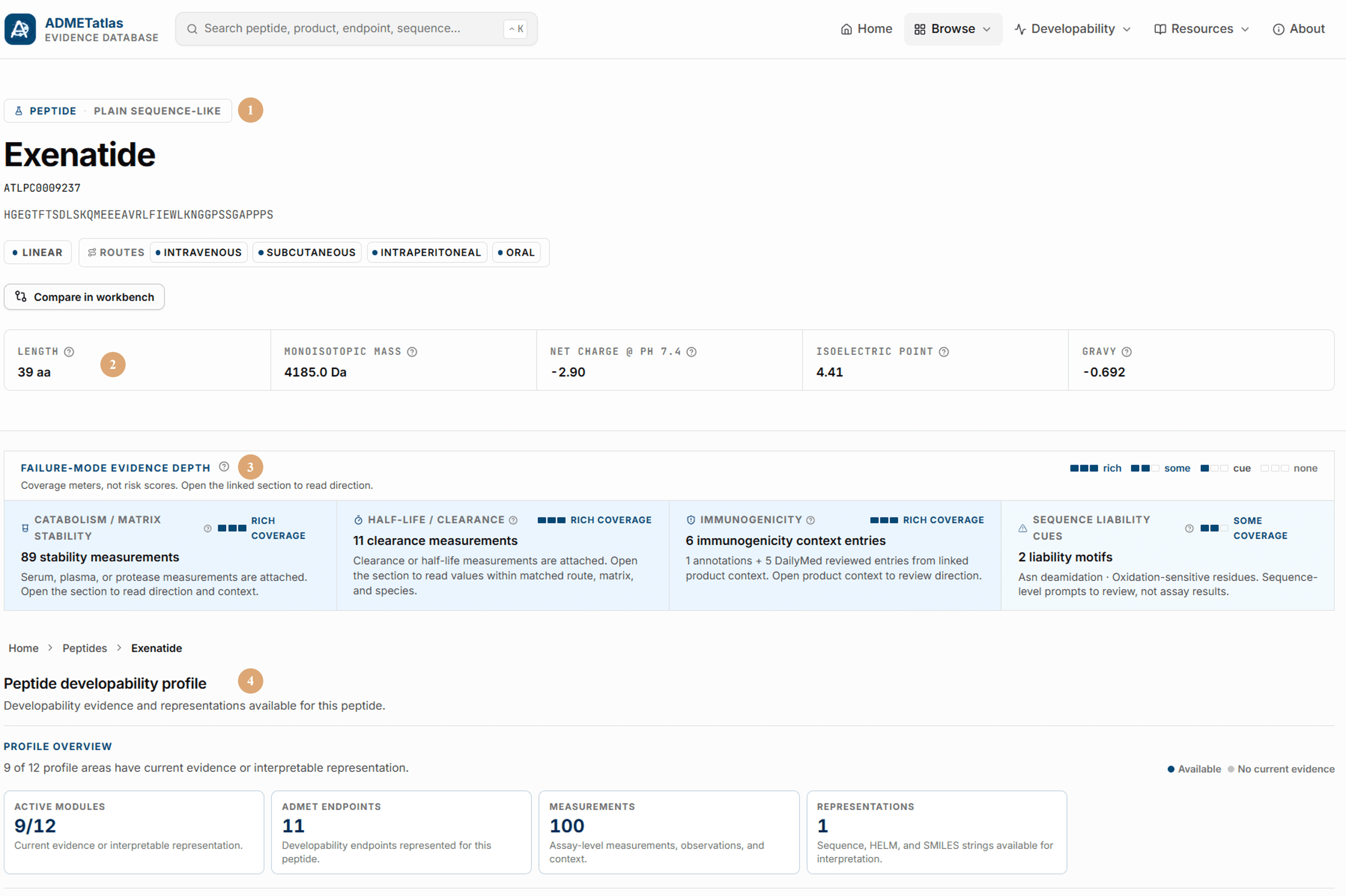
Peptide pages lead with identity and physicochemical descriptors, then summarize how much ADMET evidence is attached and link every source row.
What you see
- •Canonical identity — name, stable ATL ID, sequence, and representation class.
- •Physicochemical descriptors computed from the sequence (length, mass, net charge, pI).
- •Failure-mode evidence depth across the five formal ADMET modules — Exposure / Absorption, Distribution / Barrier, Metabolic & Proteolytic Stability, Excretion / Persistence, and Toxicity / Safety — plus a Physicochemical category (experimental lipophilicity / logD).
- •A complete evidence index for source-linked review and provenance tracing.
How to use it
- 1Start with the identity block to confirm the peptide and representation class.
- 2Read evidence depth as coverage — how much evidence is attached — not as a safety or developability score.
- 3Open a profile area or ADMET module to read its endpoint, unit, and assay-context detail.
- 4Follow the evidence index references to the original sources for reproducible analysis.
Clinical contextProduct records
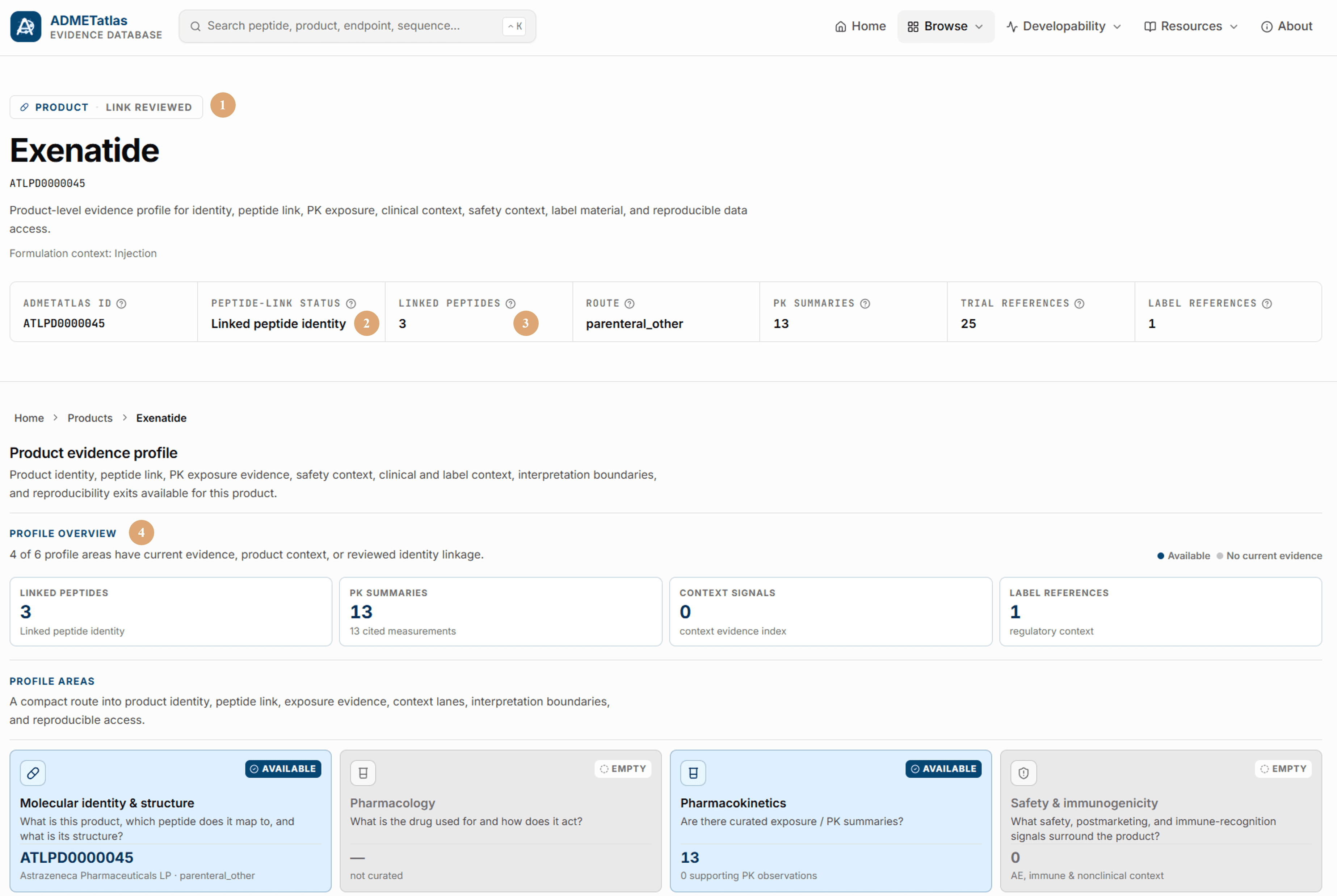
Product pages place route, formulation, label, trial, and safety context next to the linked peptide identity.
What you see
- •Product identity, route/form context, sponsor/label context, and registry identity support when available.
- •A peptide link module stating whether product context can be connected to a canonical peptide identity.
- •Exposure / PK evidence and clinical, safety, label, immune-recognition, and nonclinical context lanes.
- •Reference lineage and data-access modules for product-level reproducibility.
How to use it
- 1Confirm the product identity and route/form fields before reading PK or clinical context.
- 2Read the peptide link decision before moving from product context to peptide-level interpretation.
- 3Treat label, trial, adverse-event, immune-recognition, and identity lanes as distinct evidence contexts.
- 4Use product references to audit source-level support, not as endpoint-value replacements.
EvidenceEndpoints & evidence
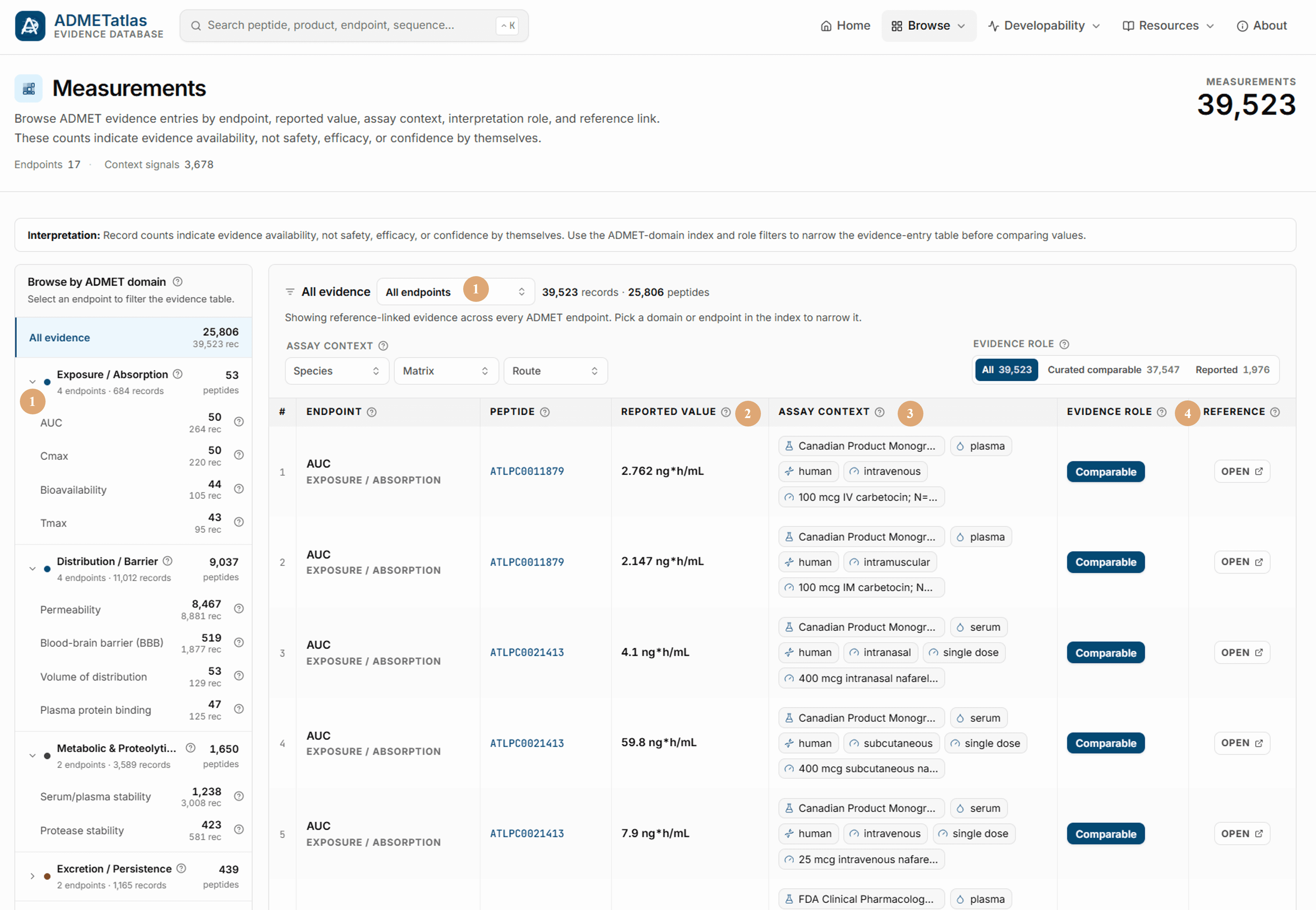
Endpoint and evidence pages expose definitions, units or metric scales, assay context, values, and references.
What you see
- •Formal endpoint definitions with default units and minimum context requirements.
- •Measurements with endpoint, value, unit or metric scale, assay/model, condition, evidence layer, and reference link.
- •Evidence layers that separate comparable measurements, reported observations, and contextual support.
- •Coverage summaries that describe evidence volume, not safety or efficacy confidence.
How to use it
- 1Start from the endpoint page when comparing a formal ADMET property.
- 2Read unit or metric scale, assay model, matrix, species, route, dose, method, and population before comparing values.
- 3Use Evidence for measurement-level filtering and detail pages for full provenance.
- 4When exporting, keep evidence layer, review status, reuse policy, and provenance attached to each row.
Reading the evidence
The same three evidence layers and the same context discipline apply everywhere in ADMETatlas. Read them before comparing any two numbers.
Comparable measurements
Structured, reference-traceable values that can be compared within their endpoint and assay context.
Use it for: Use for quantitative comparison — but only against rows sharing the same unit and assay context.
Reported observations
Reviewed findings preserved as reported, without being forced into a comparable value.
Use it for: Use as qualitative evidence and as a pointer to the source; do not average it with comparable rows.
Contextual support
Reference, label, clinical, or supporting context that helps interpretation.
Use it for: Use to orient and to navigate to sources; never as an endpoint value.
Task recipes
Common jobs, and the shortest path to each. Every recipe lands on a real page or API call.
Compare one ADMET property across peptides
- 1Open an endpoint definition (for example permeability) — reached from a developability question on Peptides.
- 2Read its default unit and minimum context note.
- 3Filter Evidence to comparable rows that share that unit and assay context.
Review a marketed product end-to-end
- 1Open the product page and confirm identity and route/form.
- 2Read the peptide link decision before reading peptide-level evidence.
- 3Work through the PK, label, trial, and safety lanes in turn.
Check a peptide's identity and references
- 1Open the peptide page and read the identity block first.
- 2Confirm the representation class and any reviewed product link.
- 3Follow the evidence index references to the original sources.
Pull the same rows programmatically
- 1Use /api/v1/search when the entity type is unknown.
- 2Query the typed endpoint (peptides, products, evidence) by stable ATL ID.
- 3Keep the review, reuse, and provenance fields in your derived tables.
API access
Every view on these pages is reachable through a public, versioned API. Pin a release, keep the status and provenance fields, and any view is reproducible.
- 1Open release_manifest.json to pin the snapshot and scope.
- 2Read schema.json and data_dictionary.tsv before parsing columns.
- 3Join records by stable ATL identifiers and keep the provenance fields.
- 4Cite the release snapshot and preserve upstream references in derived analyses.
curl -sS 'https://admetatlas.scbdd.com/api/v1/evidence?endpoint=permeability&format=json' \
-H 'accept: application/json' \
-H 'X-Visibility: public_release'Use /api/v1/search when the entity type is unknown.
Use stable peptide, product, endpoint, and evidence IDs.
Retain review, reuse, and provenance fields downstream.
Frequently asked questions
The questions first-time users ask most — including the one about empty endpoints.
Why does a peptide show no records for some endpoints?▾
Can I average or pool values across rows?▾
Is ADMETatlas free? Do I need an account?▾
What is the difference between a peptide and a product?▾
Does ADMETatlas predict ADMET properties?▾
How do I cite a value, and how are releases versioned?▾
Can I redistribute the data?▾
Glossary
The terms used in records, API responses, and release files.
Stable ADMETatlas identifier used for public-facing joins and reproducibility (for example ATLPC… for a peptide backbone, ATLPD… for a product).
The canonical molecular identity that groups one or more peptidoforms.
A specific resolved form of a backbone — its sequence and representation, including modifications or cyclization.
A measured or reported ADMET property such as permeability, plasma stability, clearance, or hemolysis.
One evidence entry: a value with its unit or metric scale and inline assay context, linked to an endpoint and a reference.
The species, matrix, route, dose, method, model, population, or other condition needed to compare values.
Whether a row is a comparable measurement, a reported observation, or contextual support.
Trial, label, safety, identity, or immune-recognition context bound to a peptide or product.
The reviewed link between a drug product and a canonical peptide identity.
The publication, label, registry, or dataset record used to trace a displayed statement.
Guidance for whether a record should be used for endpoint comparison, support, context, or identity matching.
Report a correction
Help keep the atlas accurate so others can reproduce your analysis.
Report a correction
Include the page URL, the ATL ID, the field name, the observed value, the corrected value, and a supporting reference. Precise, source-backed reports are actioned fastest.
Contact & about